learn

Food Enzyme Compliance for Maltogenic Amylase | CrumbSpan

A practical B2B guide to Maltogenic Amylase compliance considerations for bakery teams: documentation, labeling, import review, quality expectations, and supplier qualification.

Motion reference — starch structure
01
Extended softnessCrumb stays pliable further into shelf life
02
Improved resilienceBetter spring-back after slicing and transport
03
Consistent performancePredictable behavior across industrial lines

Food Enzyme Compliance Considerations for Maltogenic Amylase

Maltogenic Amylase is bought for a sensory result: softer crumb, better resilience, and longer eating quality across shelf life. Compliance work is less visible, but it is what allows that performance to move from bench trial to commercial bakery line.

For R&D, quality, regulatory, and procurement teams, the compliance question is not simply “is this enzyme allowed?” It is: can we document what it is, how it is made, where it is intended to be used, how it should be stored, and how it fits our customer and market requirements?

This guide outlines the practical review areas B2B buyers should consider when qualifying Maltogenic Amylase for bread, buns, rolls, sweet goods, tortillas, and other baked applications.

What compliance review usually covers

Food enzyme compliance is jurisdiction-specific and customer-specific. A complete review typically brings together regulatory status, supplier documentation, facility controls, labeling position, import data, and lot-level quality records.

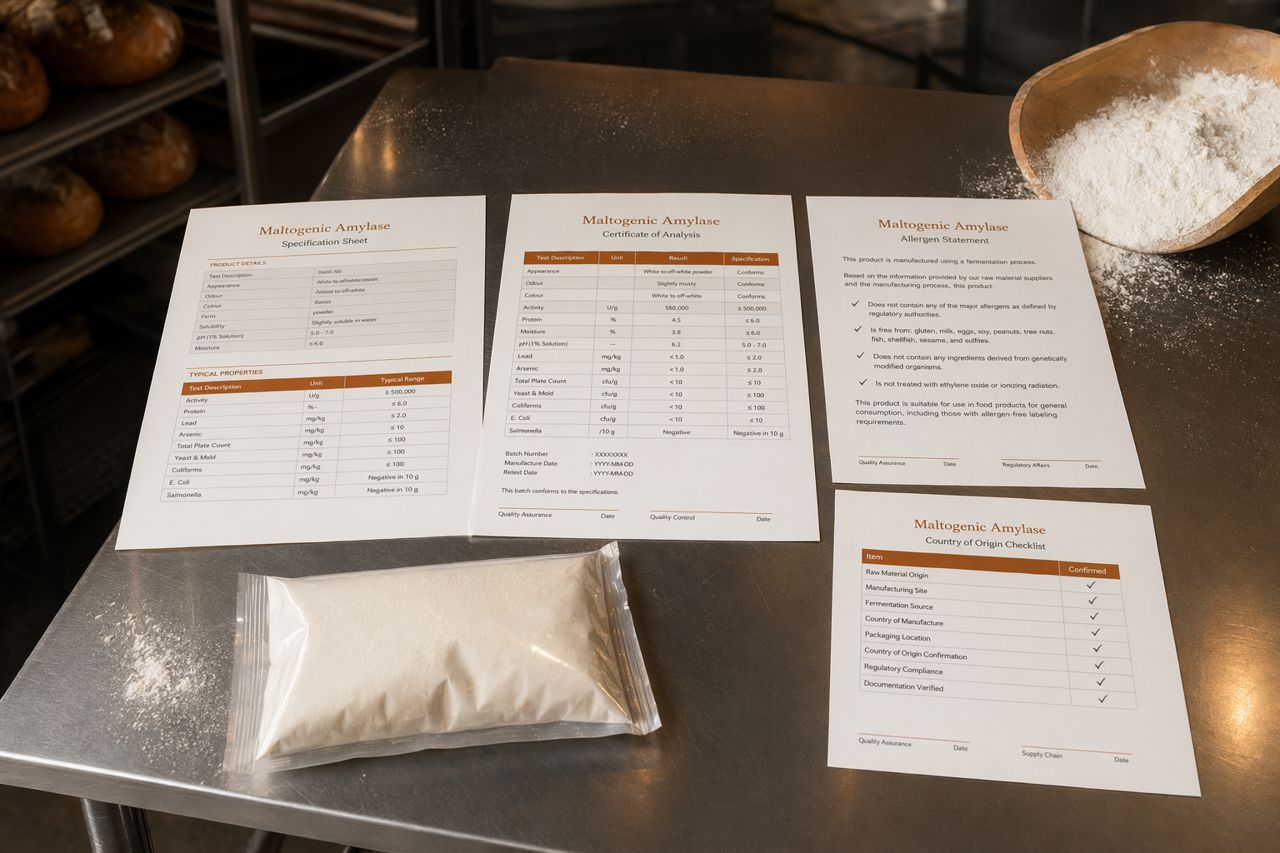
For Maltogenic Amylase, buyers commonly request:

  • Product specification or technical data sheet
  • Safety data sheet, where applicable to local requirements
  • Certificate of analysis for supplied lots
  • Allergen statement
  • GMO or bioengineering position statement
  • Country of origin and manufacturing location information
  • Source organism or production organism information, when required
  • Composition overview, including relevant carriers or processing aids
  • Shelf-life and storage conditions
  • Food contact and packaging statement, where relevant
  • Dietary or market certificates such as kosher or halal, if needed
  • Heavy metal, microbiological, or contaminant control statements when required by customer policy
  • Change-control and traceability expectations

The exact file will vary by supplier, market, and product form. The key is to request documentation early enough that regulatory review does not delay bakery trials, commercialization, or import clearance.

Processing aid or ingredient: why the role matters

Maltogenic Amylase is used to modify starch behavior during baking and storage. In many bakery systems, it is reviewed as a processing aid because its primary function occurs during dough processing, baking, and crumb aging. In other contexts, customer policy or local rules may treat the enzyme differently.

The classification can influence:

  • Finished-product label declaration
  • Internal formulation documentation
  • Customer approval language
  • Import documentation
  • Specification format
  • Claims review for shelf-life or freshness positioning

There is no universal label phrase that works for every market. Declaration decisions depend on jurisdiction, finished product category, enzyme role, carryover assessment, and retailer or brand-owner standards. CrumbSpan recommends confirming the labeling position before scale-up, especially for products sold across multiple regions.

Documentation buyers should ask for before the first commercial trial

A bakery trial should not depend on a loose product description. Before moving to pilot or production-scale testing, buyers should confirm that the supplier can support the product technically and administratively.

1. Product identity and intended use

The documentation should clearly identify the enzyme as Maltogenic Amylase and describe its intended use in bakery applications. Buyers should be able to distinguish it from fungal alpha-amylase, bacterial alpha-amylase, xylanase, lipase, or broad bakery enzyme blends.

Useful questions include:

  • Is the product a single-enzyme preparation or part of a blend?
  • What bakery formats is it intended for?
  • What functionality is being targeted: crumb softness, resilience, anti-staling, slice quality, or shelf-life extension?
  • Are there formulation constraints, such as very high sugar, high fat, frozen dough, or low-moisture systems?

2. Source and production information

Many regulatory teams need to know how the enzyme is produced and whether the production system is acceptable for the target market. This may include source organism information, fermentation controls, downstream processing, and confirmation that viable production organisms are not present in the final preparation where relevant.

The level of detail disclosed can vary because enzyme manufacturing includes proprietary processes. Even so, buyers should expect enough information for regulatory and customer qualification.

3. Composition and carrier review

Commercial enzyme preparations are not simply pure enzyme. They may include carriers, stabilizers, or standardizing materials that help maintain handling, dispersion, and storage performance. These materials can affect allergen review, label review, import paperwork, and customer approval.

Procurement and regulatory teams should confirm:

  • Whether the product is powder, granulate, or liquid
  • What carrier system is used at a high level
  • Whether any listed allergens are present or intentionally added
  • Whether the preparation is suitable for the intended bakery process and plant handling system
  • Whether dust, flowability, or hydration behavior requires special production controls

4. Lot documentation and traceability

For commercial purchasing, lot-level documentation is essential. A certificate of analysis helps connect the delivered lot to the supplier’s specification and release process. Traceability records should support recall readiness and customer audits.

Buyers should confirm:

  • Lot number format and traceability depth
  • Certificate of analysis availability
  • Shelf-life dating format
  • Storage requirements and transport considerations
  • Change notification expectations
  • Complaint and deviation handling process

Import and market access considerations

Cross-border enzyme purchasing can introduce requirements beyond normal ingredient approval. Import teams may need documentation that supports customs classification, country of origin, manufacturing location, product description, and intended use.

Depending on destination market, buyers may also need support for:

  • Food enzyme regulatory status
  • Production organism review
  • Local food additive or processing aid frameworks
  • Packaging and transport documentation
  • Language-specific documents
  • Shelf-life evidence and storage declarations
  • Customer-specific questionnaires

For multi-market bakery groups, the cleanest approach is to build a compliance matrix before ordering. List each destination country, finished-product category, customer account, and required document. This prevents a product that is acceptable in one channel from becoming blocked in another.

Labeling and claims: keep the language precise

Maltogenic Amylase can support softer crumb and improved eating quality over time, but shelf-life language must be handled carefully. Technical performance is not the same as a finished-product claim.

Before using phrases such as “longer-lasting freshness,” “reduced staling,” or “improved softness,” bakery teams should check:

  • Whether the claim is sensory, technical, or consumer-facing
  • Whether the finished product has supporting shelf-life data
  • Whether the enzyme must be declared on pack
  • Whether customer or retailer standards restrict enzyme claims
  • Whether the formulation also relies on emulsifiers, hydrocolloids, sugars, fats, or packaging changes

The strongest compliance position is built from documented trials: same formula, defined storage conditions, controlled sensory review, texture measurement where used internally, and clear comparison to the current standard.

Quality expectations for bakery manufacturers

Compliance is not only paperwork. For bakery production, the enzyme preparation must behave consistently in the plant.

Quality teams should evaluate:

  • Consistent handling and dispersion in premixes or dough systems
  • Compatibility with flour variability and bakery improver systems
  • Storage stability under real warehouse conditions
  • Packaging integrity during transit and use
  • Clear lot coding and expiry information
  • Practical support for complaints, deviations, and reformulation

Maltogenic Amylase is often used at low inclusion levels, so weighing, blending, and distribution matter. A good supplier should help teams think through where the enzyme enters the process: flour premix, improver blend, sponge, straight dough, liquid dosing system, or centralized ingredient preparation.

Procurement checklist for Maltogenic Amylase qualification

Use this checklist when comparing suppliers or preparing a customer approval package.

Regulatory and documentation

  • Confirm the enzyme identity and intended bakery use
  • Request current specification and safety documentation
  • Request allergen, GMO, origin, and dietary certification statements as needed
  • Confirm whether source or production organism information can be supplied for regulatory review
  • Confirm lot certificate availability
  • Confirm change-control notification practices

Label and customer approval

  • Determine processing aid or ingredient position by market
  • Review declaration language with internal regulatory counsel or customer standards
  • Confirm whether customer questionnaires require additional disclosures
  • Align freshness, softness, or shelf-life claims with finished-product evidence

Import and supply chain

  • Confirm country of origin and shipping documentation needs
  • Check whether the target destination requires pre-clearance or additional food enzyme review
  • Confirm shelf-life remaining on arrival
  • Review storage and transport conditions
  • Establish lead time, minimum order expectations, and continuity of supply

Plant use and quality

  • Confirm product form and handling characteristics
  • Review storage location and resealing practices
  • Validate performance in the actual flour system and process window
  • Document trial conditions and finished-product results
  • Align production, QA, and procurement on lot acceptance process

Common friction points to avoid

Waiting until launch to request documents

Compliance files can take time, especially when multiple markets or customer accounts are involved. Request the core document set before the trial plan is finalized.

Assuming one market equals global approval

A product accepted in one country may still need additional review elsewhere. Multi-region bakery programs should map each destination before scale-up.

Treating all amylases as interchangeable

Maltogenic Amylase is selected for anti-staling and crumb softness performance. It should not be documented or positioned as a generic amylase without confirming the specific enzyme identity and function.

Separating R&D results from regulatory language

If the finished-product claim depends on improved shelf life, make sure the trial design supports that language. Sensory, texture, packaging, and microbial shelf life may all be evaluated differently.

How CrumbSpan supports buyer review

CrumbSpan is built for bakery teams qualifying Maltogenic Amylase with both performance and documentation in mind. We help buyers organize the questions that matter across R&D, quality, regulatory, import, and procurement.

Typical support conversations include:

  • Which document set is needed for an initial supplier review
  • How to structure a trial for crumb softness and resilience
  • What information procurement should request before price comparison
  • How to prepare a compliance question list for customer approval
  • How to align product form, storage, and plant handling with the bakery process

We do not replace your regulatory counsel or customer approval process. We do help make the technical and procurement conversation cleaner, earlier, and more actionable.

Request pricing and compliance support

If you are qualifying Maltogenic Amylase for a bakery product, send your application details and target market requirements. CrumbSpan will respond with pricing guidance and the documentation pathway for review.

Food Enzyme Compliance for Maltogenic Amylase | CrumbSpanFood Enzyme Compliance for Maltogenic Amylase | CrumbSpanFood Enzyme Compliance for Maltogenic Amylase | CrumbSpan
01

Applications

02

Technical Library

Get a quote

Request pricing & specs

Tell us your application and volume — we reply with pricing and lead time.